You’ve tried every topical treatment. Changed your skincare routine three times. Cut out dairy, then gluten, then both. But your skin still breaks out in the same stubborn pattern, or stays perpetually dull and inflamed, or develops rashes that your dermatologist can’t quite explain.
Here’s what’s often missing from the conversation: your skin doesn’t exist in isolation. It’s connected to every other system in your body, and one of the most powerful connections runs between your gut and your face. The gut-skin axis is a bidirectional communication pathway where the health of your intestinal microbiome directly influences what shows up on your skin.
This article contains affiliate links. See our affiliate disclosure for details.
When your gut bacteria are out of balance, it doesn’t just cause digestive symptoms. It triggers systemic inflammation that travels through your bloodstream and manifests as acne, eczema, rosacea, premature aging, and chronic dullness. And in hot, hard water climates where environmental stressors already compromise your skin barrier, an unhealthy gut makes everything worse.
This is medically reviewed information about how the gut-skin connection works, what changes it, and evidence-based strategies to restore balance from the inside out. Medically reviewed by Dr. Layla Hassan, Trichologist.
What the Gut-Skin Axis Actually Is
The gut-skin axis isn’t alternative medicine. It’s an established area of dermatological research that examines how the trillions of bacteria in your intestines communicate with your skin through immune signaling, inflammatory pathways, and metabolic byproducts.
Your gut microbiome performs critical functions: it breaks down food, produces vitamins, regulates immune responses, and maintains the integrity of your intestinal barrier. When this system is diverse and balanced, it supports skin health. When it’s changeed, a condition called dysbiosis, it triggers inflammatory cascades that your skin can’t ignore.
Research published in the Journal of Clinical and Aesthetic Dermatology found that patients with acne, rosacea, and atopic dermatitis consistently show altered gut microbiome composition compared to healthy controls. The connection isn’t coincidental. It’s physiological.
The mechanism works like this: when your gut barrier becomes permeable (often called leaky gut), bacterial fragments and inflammatory molecules enter your bloodstream. Your immune system responds with systemic inflammation. That inflammation doesn’t stay localized. It travels to your skin, triggering breakouts, redness, and barrier dysfunction.
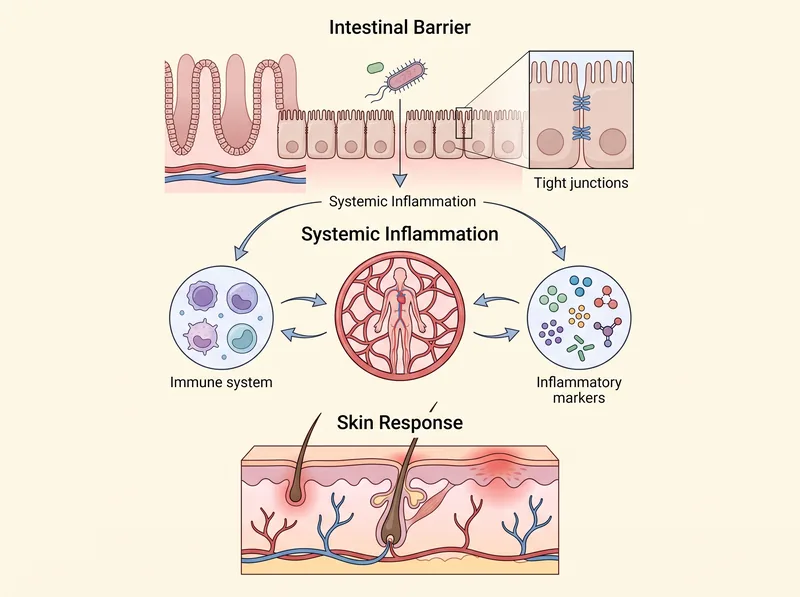 The gut-skin axis: how intestinal inflammation triggers systemic responses that manifest as skin conditions
How Gut Dysbiosis Shows Up on Your Face
Gut imbalance doesn’t produce a single skin symptom. It manifests differently depending on your genetics, environment, and which specific bacterial strains are out of balance. But there are patterns.
Inflammatory acne, particularly cystic acne that appears along the jawline and chin, often correlates with gut inflammation. Studies show that people with acne have significantly lower gut microbiome diversity than those with clear skin. The inflammatory response triggered by dysbiosis increases sebum production and creates an environment where acne bacteria thrive.
Rosacea shows one of the strongest gut connections. Research indicates that small intestinal bacterial overgrowth (SIBO) is significantly more common in rosacea patients, and treating SIBO often improves facial redness and inflammation. The mechanism involves histamine release and vascular inflammation triggered by bacterial imbalances.
Eczema and atopic dermatitis also link to gut health, particularly in cases that develop in adulthood or worsen after digestive issues. The connection involves immune dysregulation. When your gut microbiome can’t properly train your immune system, it overreacts to harmless triggers, causing the chronic inflammation that characterizes eczema.
Even general skin dullness, uneven texture, and premature aging can trace back to gut inflammation. Chronic low-grade inflammation accelerates collagen breakdown and impairs your skin’s ability to repair and regenerate. You’re not just breaking out. You’re aging faster.
What Changes Your Gut Microbiome
Understanding what damages gut health is critical because many of these factors are amplified in hot, hard water climates where expats and long-term residents face additional stressors.
Antibiotics are the most obvious changeor. A single course can reduce gut bacterial diversity for months, sometimes permanently altering your microbiome composition. This doesn’t mean you shouldn’t take necessary antibiotics, but it does mean you need to actively support gut recovery afterward.
Diet plays a massive role. Ultra-processed foods, high sugar intake, and low fiber consumption all reduce microbiome diversity. In the Gulf region, where Western fast food is ubiquitous and fresh produce can be expensive or limited in variety, maintaining a gut-healthy diet requires intentional effort. Adapting local cuisine to support nutritional needs becomes essential.
Chronic stress directly alters gut bacteria composition through the gut-brain axis. The stress of relocation, cultural adjustment, extreme heat, and demanding work schedules that many expats face creates a perfect storm for gut dysbiosis. Chronic cortisol improvion doesn’t just affect your mood. It reshapes your microbiome.
Environmental factors matter too. Hard water, chlorinated pools, and extreme heat exposure all stress your body in ways that indirectly affect gut health through increased systemic inflammation and altered hydration status. You can’t control the water quality, but you can control how you support your gut’s resilience.
 Gut-supporting foods that help maintain the microbiome diversity linked to clear skin
Evidence-Based Strategies to Support the Gut-Skin Connection
Restoring gut health isn’t about expensive cleanses or restrictive elimination diets. It’s about consistent, evidence-based practices that support microbiome diversity and reduce inflammation.
Probiotic supplementation shows the most direct evidence for skin benefits. A meta-analysis in Beneficial Microbes found that oral probiotics significantly improved acne, rosacea, and eczema symptoms. The strains matter: Lactobacillus and Bifidobacterium species show the strongest effects. Look for multi-strain formulas with at least 10 billion CFU.
Prebiotic fiber is equally important and often overlooked. Your gut bacteria need food to thrive, and that food is fiber. Aim for 25-30 grams daily from vegetables, fruits, whole grains, and legumes. Specific prebiotic foods like garlic, onions, asparagus, and Jerusalem artichokes directly feed beneficial bacteria.
Fermented foods provide both probiotics and unique bioactive compounds. Yogurt, kefir, sauerkraut, kimchi, and miso all support gut diversity. If you’re not used to fermented foods, start small. Your gut needs time to adjust.
Omega-3 fatty acids reduce systemic inflammation and support both gut barrier integrity and skin barrier function. Research on omega-3s consistently shows anti-inflammatory benefits. Aim for 2-3 servings of fatty fish weekly or consider a high-quality fish oil supplement.
Polyphenol-rich foods like berries, dark leafy greens, green tea, and dark chocolate (70%+ cacao) act as prebiotics and directly reduce inflammation. They also support the growth of beneficial bacteria while inhibiting harmful strains. These aren’t superfoods. They’re just foods that happen to support the biology you need.
The Hard Water Factor in Gut-Skin Health
Living in a hard water climate adds a layer of complexity to the gut-skin connection because you’re dealing with external barrier damage on top of internal inflammation.
Hard water changes your skin barrier through mineral buildup, pH imbalance, and surfactant interference. When your barrier is already compromised, any internal inflammation from gut dysbiosis shows up more dramatically. You’re fighting on two fronts.
This is where targeted haircare becomes part of the solution. Mineral buildup on your scalp creates inflammation that connects to the same systemic pathways affected by gut health. Using a chelating shampoo like Regrowth+ to remove mineral deposits reduces one source of chronic low-grade inflammation, allowing your body to focus resources on gut healing and skin repair.
The connection between hard water and skin barrier function is well-documented. Supporting your gut health doesn’t replace the need for external barrier protection, but it makes your skin more resilient to environmental stressors.
What to Expect When You Address Gut Health
Gut healing isn’t fast. Your microbiome didn’t become imbalanced overnight, and it won’t rebalance in a week. Realistic timelines matter.
Initial improvements in digestive symptoms (less bloating, more regular bowel movements, reduced gas) often appear within 2-4 weeks of consistent probiotic use and dietary changes. Skin improvements lag behind by several weeks because you’re waiting for inflammatory markers to decrease and for your skin’s natural turnover cycle to reflect internal changes.
Most people notice skin changes around the 6-8 week mark: reduced breakout frequency, less redness, improved texture. Significant improvements in chronic conditions like rosacea or eczema may take 3-6 months of consistent gut support.
This isn’t linear. You’ll have good weeks and setbacks. Stress, travel, illness, and dietary lapses all temporarily change progress. That’s normal. What matters is the overall trend over months, not day-to-day fluctuations.
If you see no improvement after 3 months of consistent effort, consult a healthcare professional. You may need testing for specific conditions like SIBO, inflammatory bowel disease, or food intolerances that require targeted treatment beyond general gut support.
When to Seek Professional Help
Some gut-skin issues require medical intervention, not just dietary changes and supplements.
Persistent digestive symptoms (chronic diarrhea, constipation, blood in stool, severe pain) warrant gastroenterological evaluation. These could indicate conditions like Crohn’s disease, ulcerative colitis, or celiac disease, all of which have skin manifestations.
Sudden onset of severe skin reactions, especially if accompanied by digestive symptoms, may indicate food allergies or intolerances that need professional testing. Elimination diets are useful but should be guided by a healthcare provider to avoid nutritional deficiencies.
If you’ve taken multiple courses of antibiotics recently, or if you’ve had chronic gut issues for years, consider working with a functional medicine practitioner or gastroenterologist who can order complete stool testing. These tests can identify specific bacterial imbalances, parasites, or inflammatory markers that guide targeted treatment.
The gut-skin axis is real, but it’s not the only factor in skin health. Hormonal imbalances, nutritional deficiencies, and environmental damage all play roles. A whole-body approach addresses multiple factors simultaneously.
References
- The gut-skin axis: how the microbiome influences skin health - PubMed Central
- Small intestinal bacterial overgrowth in rosacea: clinical effectiveness of its eradication - PubMed
- Oral probiotics for acne and rosacea: A systematic review - ScienceDirect
- The influence of the gut microbiome on skin barrier function - American Academy of Dermatology
- Probiotics and prebiotics in dermatology - PubMed