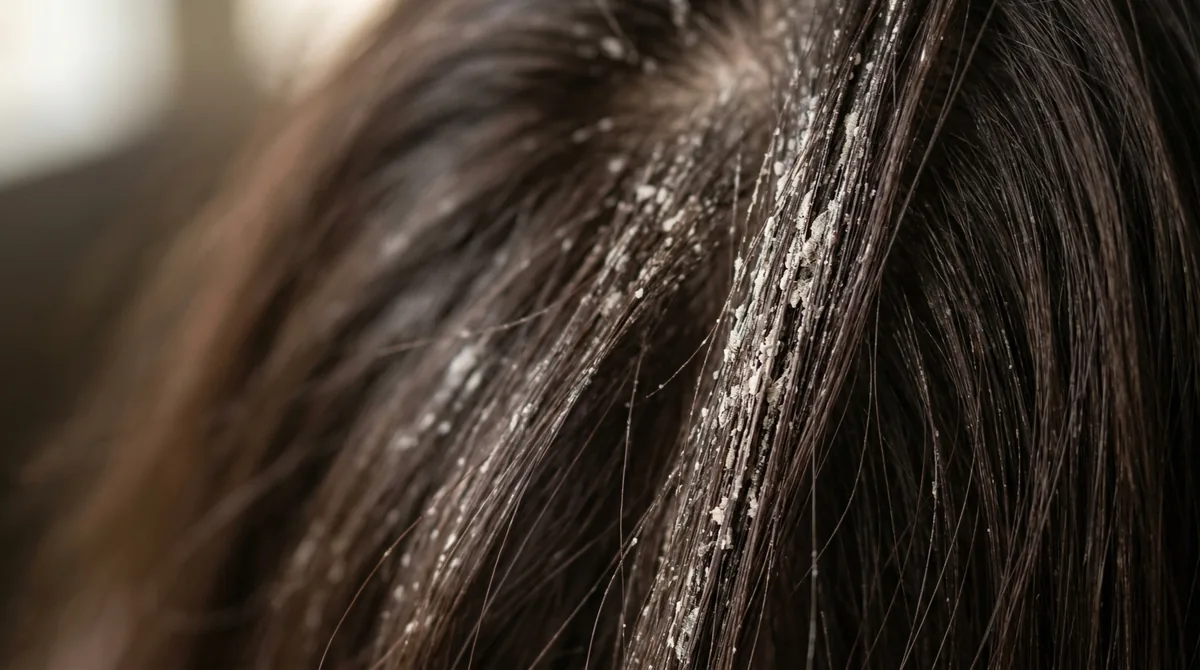
You’ve switched to sulfate-free. You deep condition religiously. You’ve tried every curl cream the internet swears by. And still, your hair feels like it’s coated in something you can’t wash out. It’s stiff, dull, won’t hold moisture, and your curls have gone from defined spirals to limp, undefined waves. Here’s what nobody tells you: it might not be your products, your technique, or your hair type. It’s likely mineral buildup, and it’s happening because of what’s in your water, not what you’re doing wrong.
This article contains affiliate links. See our affiliate disclosure for details.
Mineral buildup, also called hard water residue or calcium buildup, occurs when dissolved minerals in your water bind to your hair shaft and accumulate over time. In regions with hard water, which includes most of the Gulf, parts of the southwestern United States, and areas of Australia, this isn’t a minor cosmetic issue. It’s a progressive coating that changes your hair’s structure, blocks moisture absorption, and can even contribute to breakage and hair loss. Medically reviewed by Dr. Layla Hassan, Trichologist, this guide explains what mineral buildup actually is, how to identify it on your hair, and the scientifically backed methods to remove it.
Key Takeaways
• Mineral buildup is a coating of calcium, magnesium, and other dissolved minerals from hard water that bonds to your hair shaft and accumulates with every wash
• Common signs include hair that feels coated or waxy, loss of curl definition, products that stopped working, persistent dullness, and increased tangling or breakage
• Chelating shampoos use ingredients like EDTA or citric acid to bind to mineral deposits and remove them from hair, restoring your hair’s natural texture and porosity
• Regular clarifying shampoos remove product buildup but can’t dissolve mineral deposits, which is why they don’t solve hard water problems
• Prevention requires either treating your water source or using chelating treatments every 2-4 weeks depending on your water hardness and hair porosity
What Mineral Buildup Actually Is (And Why It’s Different from Product Buildup)
Mineral buildup is the accumulation of dissolved minerals, primarily calcium and magnesium, that deposit onto your hair shaft during washing. When you wash your hair with hard water, which contains high concentrations of these minerals, they don’t rinse away. Instead, they bond to the negatively charged proteins in your hair, forming a coating that builds up with each wash.
This is chemically different from product buildup. Product residue sits on top of your hair and can usually be removed with a clarifying shampoo. Mineral deposits actually bind to your hair’s structure. A 2017 study published in the International Journal of Trichology found that hard water significantly increases hair surface roughness and reduces tensile strength, the hair’s ability to stretch without breaking.
The minerals form a film that makes your hair feel coated, stiff, or waxy. This coating has a cumulative effect. After weeks or months of washing in hard water, the mineral layer becomes thick enough to visibly change your hair’s appearance and texture. It blocks moisture from penetrating the hair shaft, prevents conditioning ingredients from working, and creates a rough surface that causes tangling and friction damage.
What makes this particularly frustrating in dry climates is that you’re already dealing with low humidity and high heat, both of which dry out hair. When you add a mineral coating that blocks hydration, you’re fighting a losing battle. Your hair can’t absorb the moisture it desperately needs because there’s a literal barrier preventing it.
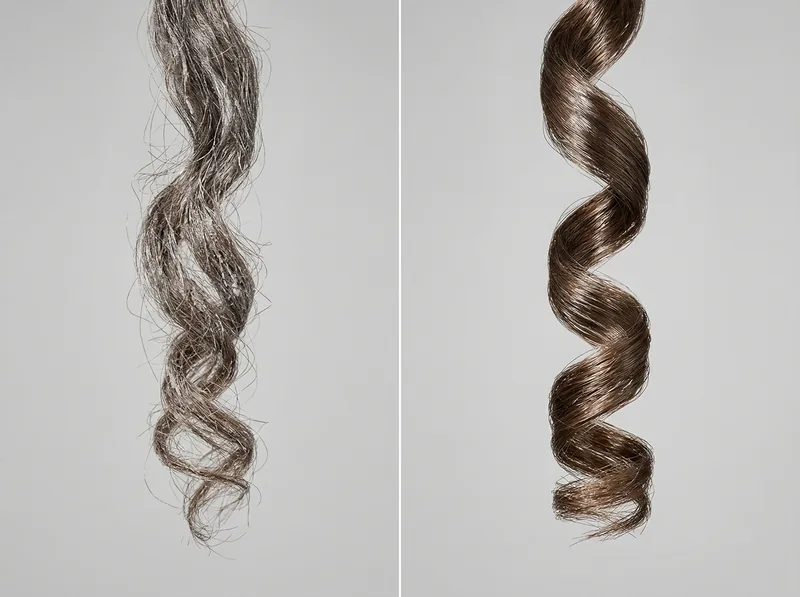 Visual comparison: mineral-coated hair (left) versus hair after chelating treatment (right), showing restored shine and curl pattern
How to Identify Mineral Buildup on Your Hair
Mineral buildup has specific visual and tactile signs that distinguish it from other hair issues. Your hair will feel coated even immediately after washing, like there’s a film you can’t rinse out. When you run your fingers down a strand, it feels rough, slightly sticky, or waxy rather than smooth. This texture persists no matter how much you rinse.
Visually, mineral buildup often appears as a dull, chalky cast, especially noticeable on dark hair. You might see white or gray residue near your roots or along your hair shaft. Some people describe it as looking like their hair has a layer of dust that won’t wash away. If you have color-treated hair, the minerals can cause brassiness or make your color look muddy and oxidized faster than normal.
For curly hair, the most telling sign is loss of curl definition. Your curls become limp, stretched out, or won’t form at all. Products that used to give you defined spirals now just sit on top of your hair without absorbing. You might notice your hair takes forever to dry because the mineral coating is preventing water from evaporating normally. And when it does dry, it feels crunchy or stiff even without styling products.
Another diagnostic sign: your hair’s porosity seems to have changed. High-porosity hair might suddenly act like low-porosity hair, refusing to absorb moisture or products. This happens because the mineral coating has sealed the cuticle, preventing anything from getting in or out. The environmental factors in your region can accelerate this process, making the buildup more severe than it would be in a softer water area.
The Science of Hard Water and Mineral Deposition
Hard water is defined by its mineral content, specifically calcium and magnesium ions. Water hardness is measured in parts per million (ppm) or grains per gallon (gpg). Water is considered hard when it contains more than 120 ppm (7 gpg) of calcium carbonate. In the Gulf region, water hardness often exceeds 300 ppm, and in some areas reaches 500-700 ppm, which is classified as very hard.
When hard water contacts your hair, the positively charged calcium and magnesium ions are attracted to the negatively charged keratin proteins in your hair shaft. This electrostatic attraction causes the minerals to bind to your hair’s surface. Each time you wash, a new layer deposits on top of the previous one. Research from the US Geological Survey shows that even moderately hard water can cause significant mineral accumulation over time.
The minerals don’t just coat the outside of your hair. They can penetrate partially opened cuticles and deposit inside the hair shaft, particularly if your hair is already damaged or porous. This internal deposition makes the hair brittle and prone to breakage. The rough mineral coating also increases friction between hair strands, leading to more tangling, mechanical damage, and breakage during detangling.
Temperature matters too. Hot water increases the rate of mineral deposition because heat causes the minerals to precipitate out of the water more readily. This is why you might notice more buildup if you wash your hair with very hot water, and it’s also why you see white scale deposits on your showerhead and fixtures. That same scale is coating your hair.
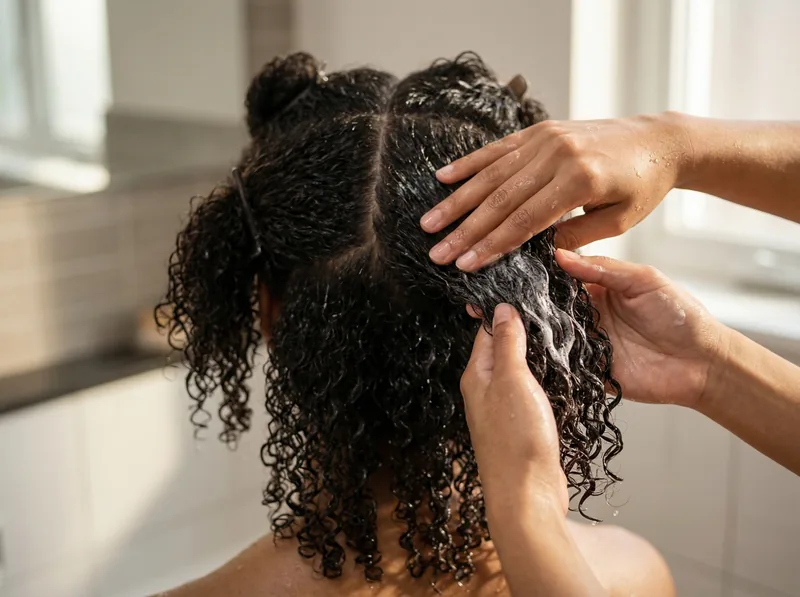 Proper chelating technique: apply to wet hair in sections, focusing on areas with the heaviest mineral accumulation
How Chelating Shampoos Remove Mineral Buildup
Chelating shampoos are specifically formulated to remove mineral deposits through a chemical process called chelation. The active ingredients in these shampoos are chelating agents, compounds that can bind to metal ions and render them water-soluble so they can be rinsed away. The most common chelating agents in hair care are EDTA (ethylenediaminetetraacetic acid), citric acid, and phytic acid.
EDTA works by forming a stable complex with calcium and magnesium ions. Its molecular structure has multiple binding sites that wrap around the metal ions, essentially trapping them. Once bound, the mineral-EDTA complex becomes water-soluble and can be rinsed out of your hair. A chelating shampoo like Regrowth+ uses this mechanism to dissolve the mineral coating without stripping your hair’s natural oils or color.
This is fundamentally different from how clarifying shampoos work. Clarifying shampoos use strong surfactants to strip away product buildup, oils, and some surface residue. They’re effective for removing styling product accumulation, but they can’t dissolve mineral deposits because they don’t contain chelating agents. You can clarify your hair weekly and still have progressive mineral buildup if you’re washing with hard water.
The chelation process requires contact time. Unlike regular shampoo that you can rinse out immediately, chelating shampoos need to sit on your hair for 3-5 minutes to allow the chelating agents to bind to the minerals. During this time, you’ll often feel your hair’s texture change as the coating dissolves. When you rinse, you’re removing both the chelating agent and the bound minerals it’s carrying away.
Step-by-Step: How to Remove Mineral Buildup from Your Hair
Start with completely wet hair. Mineral deposits are easier to remove when fully saturated because the water helps the chelating agents penetrate the coating. Apply your chelating shampoo in sections, working it through from roots to ends. Don’t just focus on your scalp. The mineral buildup is along the entire hair shaft, so you need thorough coverage.
Massage the product in gently but thoroughly. You’re not trying to create a lot of lather. Chelating shampoos often don’t foam much, especially on the first application when there’s heavy buildup. This is normal. The lack of foam doesn’t mean it’s not working. It means the surfactants are busy binding to minerals rather than creating bubbles.
Leave the shampoo on for 5 minutes minimum. Set a timer. This contact time is crucial for the chelating process to work. Some people with severe buildup leave it on for up to 10 minutes for the first treatment. You might feel your hair texture change during this time, becoming less coated and more slippery. That’s the minerals dissolving.
Rinse thoroughly with warm (not hot) water. You’ll likely notice the water feels different as you rinse, less slippery or soapy. Depending on how much buildup you have, you might need to repeat the process. For severe buildup, a second application is often necessary. After the final rinse, follow with a moisturizing conditioner because chelating treatments can be drying. Your hair’s cuticles will be clean and open, making this the ideal time to deep condition.
How Often You Need to Chelate (And Why Prevention Matters)
The frequency of chelating treatments depends on your water hardness and hair porosity. If you live in an area with very hard water (above 300 ppm), you’ll need to chelate every 2-3 weeks to prevent significant buildup. With moderately hard water (120-300 ppm), monthly chelating treatments are usually sufficient. Low-porosity hair accumulates minerals faster because the tight cuticles create more surface area for deposition, so you might need more frequent treatments.
You can test your water hardness with an inexpensive test strip kit, available at hardware stores or online. Knowing your exact water hardness helps you create a personalized chelating schedule. Some women find they need to chelate after every 6-8 washes, while others can go longer. Pay attention to when you start noticing the telltale signs: coating, dullness, loss of curl definition.
Prevention is more effective than treatment. If possible, install a shower filter, though be aware that most shower filters can’t remove dissolved minerals effectively. They can reduce chlorine and some sediment, but calcium and magnesium ions are too small for standard filtration. A water softener system for your entire home is the most effective prevention method, but it’s a significant investment and not always feasible for renters or those in temporary housing.
Another prevention strategy: do your final rinse with distilled or filtered water. Keep a pitcher of distilled water in your shower and use it for the last rinse after conditioning. This prevents new mineral deposits from forming during the rinse phase. It’s a small step that can significantly extend the time between chelating treatments. For more strategies on managing hard water’s effect on curls, see our complete protection system guide.
What Happens to Your Hair After You Remove Mineral Buildup
The transformation after your first chelating treatment can be dramatic. Your hair will feel lighter, softer, and noticeably cleaner. The coating that’s been weighing down your strands is gone, so your hair has more movement and bounce. If you have curly hair, you’ll likely see your natural curl pattern return, often tighter and more defined than it’s been in months.
Your hair’s porosity will normalize. Products that stopped working will suddenly absorb properly again. Deep conditioners will penetrate instead of sitting on top. Your hair will dry faster because water can evaporate normally rather than being trapped under a mineral coating. Colors will look brighter and more true to tone because the dulling mineral film is gone.
But here’s what you need to know: if you continue washing with hard water without regular chelating treatments, the buildup will return. This isn’t a one-time fix. It’s a maintenance practice you’ll need to incorporate into your routine as long as you’re living in a hard water area. Think of it like exfoliating your skin. You don’t exfoliate once and expect permanent results. You do it regularly to prevent buildup.
Some women report that after consistent chelating, their hair’s overall health improves. This makes sense. When your hair can properly absorb moisture and nutrients, when it’s not constantly coated in minerals that cause friction and breakage, it has a chance to recover and strengthen. Combined with proper nutritional support and environmental protection, chelating becomes part of a complete hair health strategy.
References
- Effect of Hard Water on Hair - International Journal of Trichology
- Hardness of Water - US Geological Survey
- Chelating Agents in Cosmetics - Personal Care Products Council
- Hair Structure and Chemistry - American Academy of Dermatology