
You’ve been using the same products for years. The same routine, the same techniques, the same brands your hairdresser recommended. Then you move, and suddenly nothing works. Your hair feels coarser. Drier. It tangles more easily, breaks more often, and no amount of deep conditioning seems to help. You start wondering if something’s wrong with you.
Nothing’s wrong with you. Your hair didn’t change. Your environment did. This article contains affiliate links. See our affiliate disclosure for details.
When you relocate to a region with different water chemistry, temperature extremes, or humidity levels, your hair responds to those environmental stressors in measurable, predictable ways. The texture shift you’re experiencing isn’t in your head. It’s a direct result of mineral deposits, UV damage, and moisture loss working together to alter your hair’s structure at the molecular level. Medically reviewed by Dr. Layla Hassan, Trichologist.
This isn’t about buying better products or finding the right conditioner. It’s about understanding the specific environmental factors in your new location and how they interact with your hair’s biology. Once you know what’s actually happening, you can address the root cause instead of treating symptoms.
Key Takeaways
• Hard water mineral deposits (calcium and magnesium) coat hair strands, creating texture changes that worsen with every wash over 2-6 months
• Environmental factors work together: water chemistry causes 60-70% of texture changes, while UV exposure and low humidity contribute 20-30%
• Your hair didn’t change, your environment did. The problem is external and reversible with the right approach
• Chelating treatments remove mineral buildup, while regular products can’t dissolve these deposits
• Most people notice improvement within 2-4 weeks of addressing hard water buildup, though complete restoration may take 2-3 months
The Water Chemistry Problem: Why Hard Water Changes Everything
Let’s start with the biggest factor: the water you’re washing your hair with. If you’ve moved to the Gulf region, parts of the southwestern United States, Australia, or Southern Spain, you’ve likely encountered hard water. This isn’t a minor inconvenience. It’s the primary reason your hair feels different.
Hard water contains dissolved minerals, primarily calcium and magnesium. When you wash your hair, these minerals don’t rinse away cleanly. Instead, they bind to the negatively charged proteins in your hair shaft, creating a coating that accumulates with every wash. Research published in the International Journal of Trichology found that hard water exposure significantly increases hair surface roughness and reduces tensile strength.
Here’s what that mineral coating does. It makes your hair feel coarser because you’re literally touching a layer of calcium and magnesium deposits, not your actual hair. It creates tangling because the rough surface causes strands to catch on each other. And it blocks moisture and conditioning ingredients from penetrating the hair shaft, which is why your products stopped working.
The concentration matters enormously. Water hardness is measured in parts per million (ppm) or grains per gallon. Soft water contains less than 60 ppm. Moderately hard water ranges from 61-120 ppm. Hard water exceeds 121 ppm. Many Gulf region municipalities report water hardness between 200-400 ppm. Some areas exceed 500 ppm. That’s not just hard. That’s extremely hard, and your hair is responding accordingly.
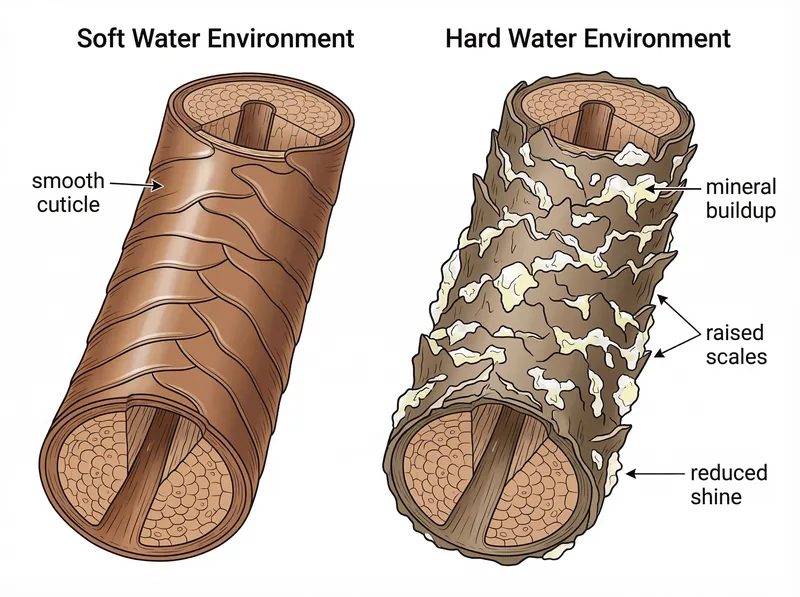 Hard water minerals create a coating on hair strands that changes texture, porosity, and how products interact with your hair.
How Mineral Deposits Actually Change Your Hair Structure
The mineral coating doesn’t just sit on the surface. It alters your hair’s fundamental properties in ways that affect everything from how it looks to how it breaks.
First, it changes porosity. Your hair’s cuticle, the outer protective layer, consists of overlapping scales that should lie relatively flat. When minerals deposit on these scales, they prop them open. This creates a rough texture and makes your hair more porous than it naturally should be. But here’s the catch: it’s not true porosity where moisture can enter and exit freely. The minerals create a barrier that prevents conditioning ingredients from penetrating while simultaneously allowing moisture to escape more easily.
Second, it affects elasticity and strength. A study in Colloids and Surfaces B: Biointerfaces demonstrated that calcium deposits significantly reduce hair’s ability to stretch and return to its original length. This means your hair breaks more easily during styling, detangling, or even just from friction against your pillow at night.
Third, it impacts color. Whether your hair is natural or dyed, mineral buildup causes visible dullness. For colored hair, it’s worse. The minerals interfere with how light reflects off the hair shaft, making your color look muddy or brassy. They also speed up color fading by creating a rough surface that allows color molecules to escape more easily during washing.
Temperature and UV Exposure: The Second Environmental Factor
Water chemistry is the primary culprit, but temperature and UV exposure compound the damage. If you’ve moved to a region with intense sun and high temperatures, you’re dealing with a second environmental stressor that works synergistically with hard water.
UV radiation breaks down the proteins in your hair shaft through a process called photodegradation. Research in the Journal of Cosmetic Science shows that UV exposure causes oxidative damage to hair proteins, particularly cysteine, which is essential for maintaining hair’s structural integrity. This damage is cumulative. The longer you’re exposed, the more protein degradation occurs.
High temperatures accelerate moisture loss. Your hair’s natural moisture content sits around 10-13% in moderate climates. In hot, dry environments, that can drop to 7-9% or lower. When hair loses moisture, it becomes brittle, more prone to breakage, and less elastic. The cuticle scales also lift slightly in response to dehydration, creating more surface roughness.
Here’s where it gets worse: mineral deposits from hard water make your hair more vulnerable to UV damage. The calcium and magnesium coating acts like a magnifying glass, concentrating UV rays and intensifying photodegradation. You’re not just dealing with two separate problems. You’re dealing with two problems that make each other worse.
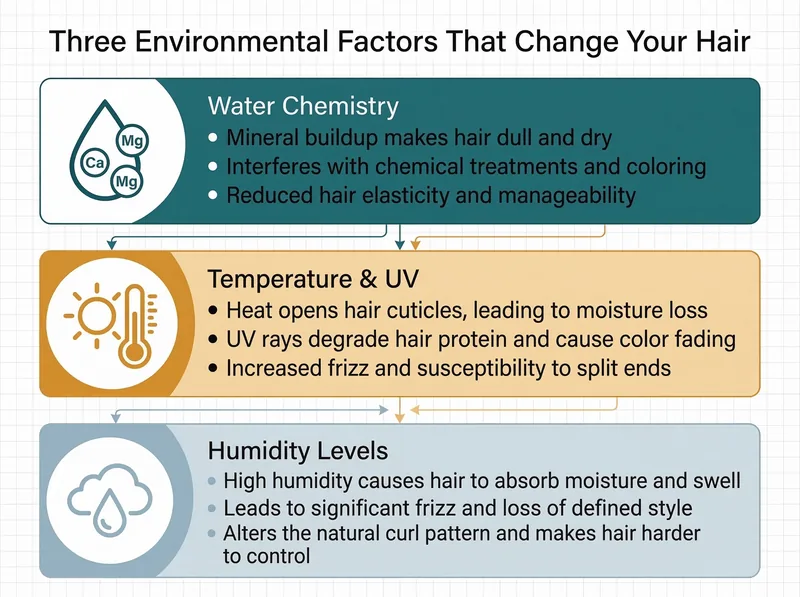 Environmental factors work together to change how your hair behaves, with water chemistry playing the primary role.
Humidity Levels and Moisture Balance
The third environmental factor is humidity, or more accurately, the lack of it. If you’ve moved from a humid climate to an arid one, you’ve probably noticed your hair behaving completely differently in terms of frizz, static, and overall manageability.
Hair is hygroscopic, meaning it absorbs and releases moisture based on the surrounding environment. In high humidity, hair absorbs moisture from the air, which can cause frizz in naturally curly or wavy hair. In low humidity, hair releases moisture to the air, leading to dryness, brittleness, and static.
Many Gulf region areas maintain relative humidity below 30% for significant portions of the year, with some desert regions dropping below 20%. For context, most hair care product testing occurs at 50-60% relative humidity. Your products weren’t formulated for the environment you’re now living in.
But here’s the critical interaction: mineral buildup from hard water changes your hair’s natural ability to regulate moisture. Even in slightly higher humidity, hair coated with calcium and magnesium can’t absorb moisture efficiently. The mineral barrier blocks water molecules from penetrating the hair shaft. This is why humectant-based products, which are supposed to draw moisture from the air into your hair, often stop working after you move to a hard water area.
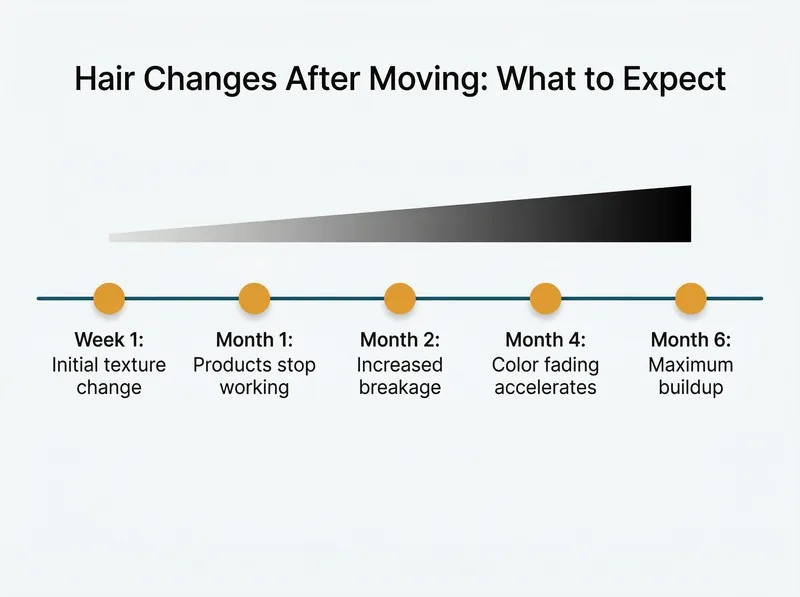 Most people notice progressive changes over 2-6 months as mineral buildup accumulates with each wash.
Why Your Products Stopped Working
This is the question that frustrates people most. You’re using the same shampoo, conditioner, and styling products that worked perfectly in your previous location. Now they do nothing. Or worse, they seem to make your hair feel even more coated and heavy.
The answer lies in how products interact with mineral deposits. Most conditioning ingredients work by depositing beneficial oils, proteins, or silicones onto the hair shaft. But when your hair is already coated with calcium and magnesium, these ingredients can’t make proper contact with your actual hair. They’re sitting on top of the mineral layer, creating a heavy, greasy feeling without providing any real conditioning benefit.
Sulfate-free shampoos, which are gentler and better for most hair types in soft water areas, often can’t remove mineral buildup effectively. They’re designed to cleanse without stripping natural oils, but they lack the stronger detergent action needed to break down mineral deposits. You end up in a cycle where you’re washing your hair but not actually cleaning it.
The same issue affects styling products. Gels, mousses, and creams that used to define your curls or add volume now just sit on the surface, creating crunch or stickiness. They can’t penetrate through the mineral barrier to interact with your hair’s natural texture. This is why people often describe their hair as feeling ‘coated’ or ‘waxy’ after moving to hard water areas.
The Timeline: When Changes Become Noticeable
Understanding when and how these changes occur helps you recognize what’s happening and take action before damage becomes severe. Most people follow a predictable progression.
In the first week or two, you might notice subtle texture changes. Your hair might feel slightly different when wet, or it might take longer to dry. These early signs are easy to dismiss as adjustment to a new climate or stress from moving. But they’re actually the first indication that minerals are beginning to deposit on your hair.
By the one-month mark, the changes become obvious. Products that worked before stop delivering results. Your hair feels drier despite using the same conditioner. You might notice increased tangling or breakage. This is when most people start buying new products, trying different brands, or increasing how much conditioner they use. None of this addresses the underlying problem.
At two to three months, the buildup is substantial. Your hair might feel noticeably coarser or rougher. If you have color-treated hair, you’ll see faster fading or brassiness. Curls lose definition. Straight hair loses shine. This is also when scalp issues often emerge, as mineral deposits can irritate the scalp and change its natural pH balance, as discussed in our article on how hard water affects your skin barrier.
By six months, you’ve reached maximum buildup for your particular hair type and washing frequency. The damage plateaus because you’re removing roughly as much mineral deposit with each wash as you’re adding. But you’re stuck at this new, worse baseline. Your hair has fundamentally different properties than it did before you moved.
Why Standard Solutions Don’t Work
When people realize their hair has changed, they typically try one of several standard solutions. More conditioner. Leave-in treatments. Hair masks. Switching to ‘moisturizing’ or ‘repairing’ product lines. Occasionally, they’ll try clarifying shampoos.
These approaches fail because they don’t address mineral buildup. Adding more conditioning products just layers more ingredients on top of the existing mineral coating. You’re not moisturizing your hair. You’re moisturizing calcium deposits. The products can’t penetrate to reach your actual hair shaft.
Clarifying shampoos remove product buildup, oils, and some surface residue. But most clarifying formulas aren’t designed to dissolve mineral deposits. They use stronger detergents to strip away organic compounds, but calcium and magnesium are inorganic minerals that require a different chemical approach. You might feel temporarily cleaner after using a clarifying shampoo, but the mineral layer remains.
Some people try apple cider vinegar rinses, which have a long history in natural hair care. The acidic pH can help smooth the cuticle and remove some surface buildup. But vinegar isn’t strong enough to dissolve substantial mineral deposits. It’s like trying to remove rust with lemon juice. It might work on very light surface oxidation, but it can’t address deeper corrosion.
The Chelation Solution: Removing What’s Actually There
The effective solution to mineral buildup is chelation. This is a chemical process where specific ingredients, called chelating agents, bind to metal ions and minerals, allowing them to be rinsed away. It’s not a new concept. Chelating agents are used in water treatment, medicine, and industrial cleaning. In hair care, they specifically target the calcium and magnesium deposits that hard water leaves behind.
The most common chelating agents in hair care products are EDTA (ethylenediaminetetraacetic acid), citric acid in higher concentrations, and sodium gluconate. These ingredients work by forming complexes with mineral ions, essentially grabbing onto the calcium and magnesium and preventing them from binding to your hair. When you rinse, the minerals wash away instead of staying deposited on the hair shaft.
A chelating shampoo like Regrowth+ is specifically formulated to remove hard water buildup while preparing the scalp for better absorption of growth-supporting ingredients. Unlike regular shampoos, chelating formulas are designed to dissolve and remove mineral deposits without over-stripping your hair’s natural oils.
Most people notice improvement within two to four weeks of starting a chelating treatment routine. Your hair will feel cleaner, lighter, and more responsive to conditioning products. Complete restoration of your hair’s pre-move texture typically takes two to three months, depending on how much buildup has accumulated and how frequently you wash your hair.
Protecting Your Hair Going Forward
Once you’ve removed existing mineral buildup, the goal is preventing it from accumulating again. This requires a different approach to hair care than what worked in your previous location.
First, incorporate chelating treatments into your regular routine. How often depends on your water hardness and washing frequency. For extremely hard water (above 250 ppm), you might need to chelate weekly. For moderately hard water (120-250 ppm), every two weeks is typically sufficient. This isn’t about stripping your hair. It’s about preventing minerals from building up to problematic levels.
Second, adjust your conditioning approach. With mineral buildup under control, your hair can actually absorb conditioning ingredients again. But you’ll likely need less product than before. Start with smaller amounts and increase only if needed. Many people find they can use lighter conditioners once their hair isn’t fighting against a mineral barrier.
Third, add UV protection. Look for leave-in products or styling products that contain UV filters. These ingredients absorb or reflect UV radiation before it can damage hair proteins. This is particularly important if you’re in a region with intense sun exposure. The investment in UV protection products is significantly cheaper than dealing with the damage from unprotected exposure.
Fourth, consider your water source for final rinses. Some people install whole-house water softeners, which remove minerals before water enters your plumbing. Others use shower filters, though these vary widely in effectiveness. A simpler approach: do a final rinse with distilled or filtered water after conditioning. This prevents new mineral deposits from forming while your hair is most vulnerable.
When to Expect Results and What to Look For
Managing expectations is important. Your hair won’t return to its pre-move state overnight. But you should see measurable improvement following a clear timeline if you’re addressing the environmental factors correctly.
In the first week of chelating treatments, you’ll notice your hair feels cleaner and lighter after washing. It should rinse more easily, without that characteristic ‘squeaky’ or ‘sticky’ feeling that mineral-coated hair has when wet. This is your first sign that minerals are being removed.
By weeks two to three, your products will start working again. Conditioner will feel like it’s actually conditioning rather than just sitting on the surface. Styling products will deliver the results they’re supposed to. If you have curly hair, you’ll see improved curl definition. If you have straight hair, you’ll see returning shine.
At the one-month mark, texture improvements become obvious. Your hair should feel noticeably softer and smoother. Tangling decreases. Breakage reduces. If you’ve been experiencing scalp issues related to hard water, like itching or flaking, these should be improving as well.
By two to three months, you’ve reached a new equilibrium. Your hair has adapted to the environmental conditions, but you’ve removed the primary stressor (mineral buildup) that was causing damage. This is your new baseline. It might not be identical to how your hair behaved in your previous location, particularly if you’re dealing with significantly different humidity or UV exposure, but it should be healthy, manageable, and responsive to your hair care routine.
References
- Effect of hard water on hair - International Journal of Trichology
- Impact of hard water on hair fiber properties - Colloids and Surfaces B: Biointerfaces
- Photodegradation of hair by UV radiation - Journal of Cosmetic Science
- Water Hardness and Geographic Distribution - US Geological Survey
- Chelating Agents in Cosmetic Products - Personal Care Products Council