
Three months after your international move, you’re standing in the shower watching more hair circle the drain than you’ve ever seen before. You tell yourself it’s stress. You tell yourself it’s temporary. But the hair keeps falling, and nobody warned you this would happen.
Here’s what the relocation industry won’t tell you: hair loss during the first year abroad follows a predictable timeline. It’s not random, and it’s not entirely about stress. Your hair is responding to a perfect storm of environmental changes that most expats don’t understand until they’re already experiencing significant shedding.
This article contains affiliate links. See our affiliate disclosure for details.
The timeline matters because intervention windows are narrow. What you do in month two will determine whether you’re dealing with temporary shedding or prolonged thinning. What you ignore in month six could mean spending your entire second year trying to recover density you could have protected.
Key Takeaways
• Hair loss after relocation typically peaks between months 2-4, following a predictable telogen effluvium pattern triggered by multiple stressors simultaneously.
• The critical intervention window is months 1-2, before peak shedding begins. Early action on water quality and scalp health can reduce total hair loss by up to 40%.
• Environmental factors (hard water, climate, UV exposure) compound physiological stress, creating a more severe response than stress alone would cause.
• Most expats see stabilization around month 6-7, with visible regrowth by month 9, but this requires active intervention, not passive waiting.
• Second-year hair health depends entirely on first-year adaptation strategies. Without intervention, chronic low-level shedding often continues indefinitely.
Month 0-1: The Deceptive Calm (And Why It Matters Most)
Your hair looks fine. Feels normal. You’re focused on unpacking boxes and figuring out where to buy groceries. This is the month most expats waste.
Here’s what’s actually happening beneath your scalp: your hair follicles are already responding to the environmental shift. Research on telogen effluvium shows that hair follicles enter the resting phase (telogen) approximately two to three months before you see shedding. The trigger happens now. The visible loss comes later.
The environmental assault begins immediately. If you’ve moved to a hard water region, every shower is coating your hair shaft with mineral deposits. Hard water’s calcium and magnesium ions bind to your hair’s keratin structure, creating a progressively thicker buildup that prevents moisture penetration and weighs down the follicle.
Your body is also flooding with cortisol. The stress of relocation, even when it’s exciting, triggers the same physiological response as trauma. Cortisol constricts blood vessels in your scalp, reducing nutrient delivery to follicles. It also pushes a higher percentage of follicles into telogen phase simultaneously, setting up the synchronized shedding you’ll see in month three.
What you should do right now: switch to a chelating shampoo like Regrowth+ to prevent mineral accumulation before it starts. Install a shower filter if you’re in a known hard water area. Start a basic supplement protocol with vitamin D (most expats are deficient after moving to sunny climates, counterintuitively), iron if you’re female, and omega-3s for scalp inflammation.
This is your prevention window. Miss it, and you’re managing damage instead of preventing it.
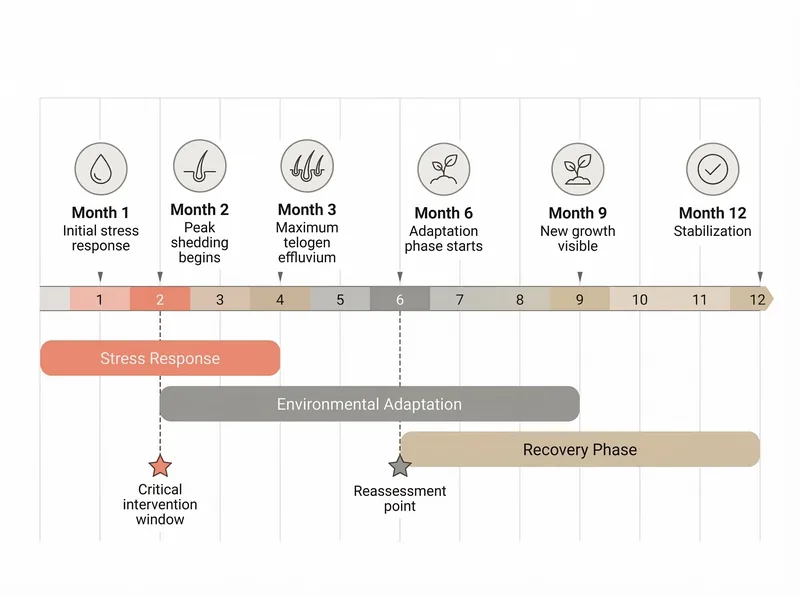 The typical progression of relocation-related hair changes, with key intervention windows highlighted
Month 2-3: Peak Shedding Begins (The Panic Phase)
This is when you notice. You’re losing 150-300 hairs daily instead of the normal 50-100. Your ponytail feels thinner. You start photographing your hairline because you can’t tell if it’s receding or if you’re imagining things.
You’re not imagining it. This is telogen effluvium in full swing, the most common form of hair loss after major life stressors. The follicles that entered resting phase during your first month are now releasing their hair shafts simultaneously. It’s a delayed reaction, which is why it feels so disconnected from the move itself.
The shedding often concentrates at the temples and crown first. Women notice it more in the part line. Men see it at the frontal hairline. This isn’t male or female pattern baldness, though it can look similar. The difference is that telogen effluvium is diffuse and temporary if the trigger is removed.
Environmental factors are now compounding the stress response. If you didn’t address hard water in month one, you’re dealing with significant mineral buildup that’s making every hair shaft brittle. The combination of physiological stress and environmental damage creates a worse outcome than either factor alone would cause.
Climate stress adds another layer. If you’ve moved from a temperate zone to a desert or tropical environment, your scalp is struggling with extreme dryness or humidity. UV radiation damage to the scalp increases oxidative stress in follicles, particularly for people with light-colored hair or thin density.
What to do now: don’t panic, but do act. This is still within the intervention window. Focus on three things. First, reduce scalp inflammation with gentle, sulfate-free cleansing and anti-inflammatory ingredients like rosemary oil or caffeine-based treatments. Second, support follicle health from inside with protein intake (aim for 0.8g per kg of body weight minimum) and B-complex vitamins. Third, protect your scalp from environmental damage with UV-protective hair products and physical barriers like hats or scarves when outdoors.
Do not start harsh treatments like minoxidil yet. Telogen effluvium resolves on its own once triggers are removed. Aggressive intervention this early can cause additional shedding.
Month 4-5: The Plateau (Waiting for Reversal)
Shedding continues but starts to slow. You’re still losing more hair than normal, but the daily count is dropping from 300 to 200, then to 150. This is the plateau phase, where your body begins adapting to the new environment.
The psychological impact peaks here. You’ve been watching your hair fall out for two months. You’re exhausted from the constant vigilance. Every shower feels like a countdown. This is when most expats either commit to a recovery protocol or give up and assume this is just their new normal.
Don’t accept it as normal. Your hair is still responding to environmental conditions that can be modified. If you’re in a hard water area and haven’t addressed it, you’re prolonging the recovery phase unnecessarily. If you’re not protecting your scalp from climate extremes, you’re creating chronic low-level stress that prevents full recovery.
Physiologically, your follicles are trying to shift back into anagen (growth) phase. But the transition is slow and requires optimal conditions. Follicles need adequate blood flow, which means managing stress and ensuring cardiovascular health. They need nutrients, particularly iron, zinc, and biotin. And they need a clean, healthy scalp environment without inflammation or buildup.
This is also when you might notice changes in hair texture. New growth coming in may be finer or more wiry than your original hair. This is normal during recovery and usually normalizes over the next six months. It’s a sign that follicles are producing new shafts, even if they’re not yet at full diameter.
What to focus on: consistency. Whatever protocol you started in month two, maintain it. Add scalp massage to improve blood flow (five minutes daily with fingertips, not nails, using gentle circular motions). Consider adding hair-supportive foods like salmon, eggs, spinach, and nuts to your daily diet. Track your progress with monthly photos in the same lighting and position so you can see improvement even when daily observation feels discouraging.
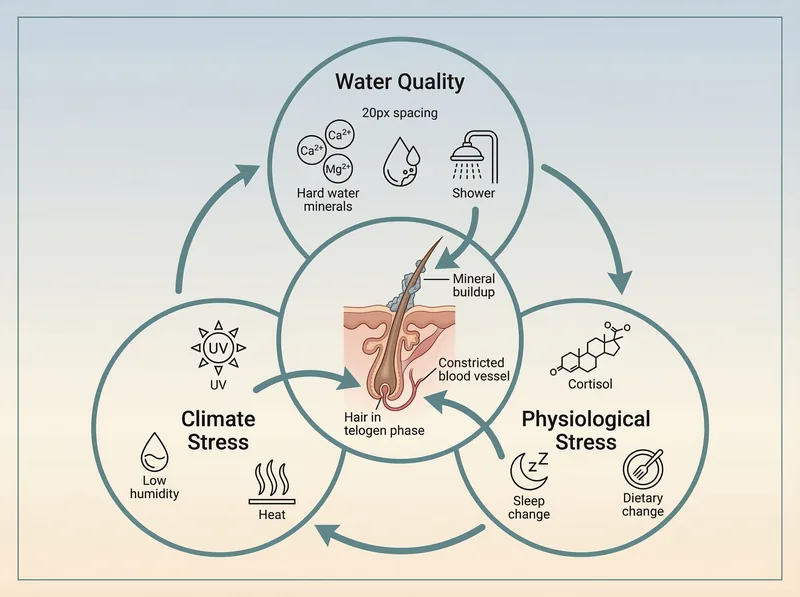 How water quality, climate, and stress converge to impact hair health during the first year abroad
Month 6-7: Early Stabilization (The Reassessment Point)
Shedding should be approaching normal levels now, around 100 hairs daily or slightly above. If you’re still losing 200+ hairs at month six, something else is wrong. This is your reassessment point.
Persistent shedding beyond six months suggests either an unresolved environmental trigger or an underlying condition that the relocation unmasked. The American Academy of Dermatology recommends medical evaluation for hair loss lasting longer than six months, as it may indicate thyroid issues, iron deficiency anemia, or other conditions that require treatment.
For most expats who took early action, month six brings visible improvement. Your ponytail still feels thinner than pre-move, but it’s not getting worse. You’re seeing baby hairs along your hairline, short fuzzy growth that indicates follicles have returned to anagen phase. This new growth won’t add noticeable density for another three months, but it’s proof of recovery.
Environmental adaptation is also stabilizing. Your body has adjusted to the new climate’s humidity levels. Your skin barrier has adapted to different water chemistry (though hard water damage continues if unaddressed). Your stress hormones have normalized as the relocation becomes routine rather than acute change.
This is the month to evaluate what worked and what didn’t. If you started five different supplements and three topical treatments, you can’t tell which helped. Consider scaling back to the essentials: a chelating shampoo for mineral removal, a scalp-supportive conditioner, one evidence-based supplement (like iron if you were deficient), and consistent scalp care. Simplicity improves compliance, and compliance determines long-term outcomes.
What to watch for: changes in hair texture or growth pattern that persist beyond this point may be permanent adaptations to the new environment. Some expats find their naturally straight hair develops wave in humid climates, or their curly hair relaxes in dry heat. This isn’t damage but structural adaptation to different atmospheric water content.
Month 8-10: Visible Regrowth (The Confidence Return)
This is when you stop thinking about your hair every morning. The baby hairs from month six are now two to three inches long, adding visible density to your hairline and part. Your overall volume is improving, though it may not be back to pre-move levels yet.
New growth comes in at about half an inch per month, so the hairs that started growing in month three are now three to four inches long. They’re long enough to blend with your existing hair and contribute to overall fullness. You might still see a difference in photos, but casual observers no longer notice thinning.
For some expats, this is full recovery. For others, it’s 80% recovery with persistent low-level thinning in high-stress areas like the temples or crown. The difference usually comes down to whether environmental triggers were fully addressed or just partially managed.
Texture changes become more apparent now. If your hair is going to permanently change in response to the new climate, you’ll see it clearly by month nine. Curly-haired expats in dry climates often report looser curl patterns. Straight-haired expats in humid zones may develop wave or frizz that wasn’t present before. These changes reflect alterations in the hair’s disulfide bonds and hydrogen bonding patterns in response to atmospheric moisture.
Scalp health should be fully normalized. If you’re still experiencing itching, flaking, or sensitivity at this point, you’re dealing with a separate issue like seborrheic dermatitis or contact dermatitis from local water or products. These conditions require targeted treatment, not just time.
Month 11-12: The New Baseline (Planning Year Two)
One year post-move, your hair has established its new normal. For most expats who intervened early, this means density within 90-95% of pre-relocation levels. For those who didn’t address environmental factors, it often means chronic low-level thinning that persists indefinitely.
This is your baseline for year two. If you’re satisfied with your hair health now, your current routine is working and should be maintained. If you’re still struggling with thinning, density loss, or texture changes you don’t like, year two requires a different strategy focused on growth stimulation rather than damage prevention.
The most common mistake expats make at the one-year mark is assuming they can return to their pre-move hair care routine. You can’t. Your hair exists in a different environment now with different water chemistry, climate conditions, and UV exposure. The products and methods that worked in your home country may actively damage your hair in your new location.
Hard water, if present, requires permanent protocol changes. You can’t occasionally use a chelating shampoo and expect good results. You need consistent mineral removal, either through chelating products, shower filtration, or both. The Curly Girl Method, for example, fails completely in hard water regions without modification.
Climate adaptation is also permanent. If you’ve moved to a desert environment, your hair needs ongoing humidity support through leave-in conditioners and oils. If you’ve moved to a tropical zone, you need lightweight products that don’t encourage fungal growth or sebum oxidation. Your year-two routine should reflect these permanent environmental realities.
What to plan for year two: shift focus from crisis management to improvation. Consider professional treatments like scalp peels or PRP therapy if density hasn’t fully recovered. Explore evidence-based growth ingredients like minoxidil or rosemary oil if you want to exceed your baseline. Invest in a proper shower filter if you haven’t already. And most importantly, maintain the habits that got you to this point rather than sliding back into neglect.
When the Timeline Doesn’t Match: Red Flags to Watch
Not every expat follows this timeline. Some experience minimal shedding and full recovery by month four. Others see progressive worsening that doesn’t plateau at month six. Knowing when your experience deviates from the typical pattern is critical.
Red flag one: shedding that starts immediately after the move or even before. True telogen effluvium has a two to three month delay between trigger and shedding. If you’re losing hair within weeks of relocation, you’re dealing with something else, possibly androgenetic alopecia that the stress unmasked or an acute illness that coincided with your move.
Red flag two: shedding that doesn’t plateau by month six. Telogen effluvium is self-limiting. If you’re still losing 200+ hairs daily at month seven or eight, you have either an unresolved environmental trigger (most commonly untreated hard water or severe nutrient deficiency) or an underlying medical condition like thyroid dysfunction or autoimmune alopecia.
Red flag three: patchy hair loss rather than diffuse thinning. Telogen effluvium causes overall density reduction, not bald spots. If you’re seeing distinct patches of hair loss, you may have alopecia areata, a fungal infection, or traction alopecia from new styling habits. These require medical diagnosis and treatment.
Red flag four: hair loss accompanied by other symptoms like fatigue, weight changes, temperature sensitivity, or skin changes. These suggest systemic illness rather than simple stress response. Thyroid disorders, iron deficiency anemia, and autoimmune conditions commonly present with hair loss as an early symptom.
When to see a doctor: if shedding exceeds six months, if you see bald patches, if hair loss is accompanied by scalp pain or unusual symptoms, or if you’re losing more than 50% of your original density. A dermatologist or trichologist can perform a scalp examination, pull test, and blood work to identify underlying causes that won’t resolve without treatment.
The Second-Year Reality: What Recovery Actually Looks Like
Let’s be honest about expectations. Most expats don’t return to exactly their pre-move hair. They return to 90-95% of original density with some permanent texture changes. This isn’t failure. It’s adaptation.
Your hair is a biological structure responding to environmental inputs. When those inputs change permanently (new water chemistry, new climate, new UV exposure), the output changes too. You can minimize damage and support optimal health, but you can’t force your hair to behave as if the environment hasn’t changed.
Some changes are actually improvements. Expats who moved from polluted cities to cleaner environments often report healthier, shinier hair in year two despite the initial shedding. Those who moved from cold, dry winters to moderate climates may find their hair less brittle and easier to manage once the transition period ends.
Other changes require acceptance. If you had thick, coarse hair and moved to a humid tropical climate, it may permanently become finer and more prone to frizz. If you had fine, straight hair and moved to a dry desert, it may become coarser and more resilient. These are structural adaptations to atmospheric water content and can’t be reversed by products alone.
The goal for year two isn’t to recreate your old hair. It’s to improve your new hair in its new environment. That means finding products formulated for local water chemistry, protecting against local climate extremes, and adjusting your expectations to match biological reality.
Success in year two looks like this: stable density that doesn’t decline further, healthy scalp with no persistent inflammation or discomfort, hair that responds predictably to your routine, and enough confidence to stop obsessing over every shed hair in the shower.
References
- Telogen Effluvium: A Review of the Literature - PubMed - Journal of the American Academy of Dermatology
- Effects of UV Radiation on Hair and Scalp - PubMed Central - International Journal of Trichology
- Hair Loss: Causes and Treatments - American Academy of Dermatology
- Hair Loss: Diagnosis and Treatment - Mayo Clinic
- Hard Water Effects on Hair and Skin - International Journal of Trichology