This article contains affiliate links. See our affiliate disclosure for details.
You’re packing for a two-week trip that spans three climates. Your hair behaved perfectly in London’s soft water, but you’re headed back to the Gulf where it’ll turn to straw within 48 hours. Or you’re leaving the region’s hard water for a beach holiday in Bali, and you know your usual products won’t work there either.
The problem isn’t that you’re high-maintenance. It’s that water chemistry, humidity levels, and UV intensity change dramatically between destinations, and your skin and hair respond to those shifts whether you’re prepared or not. What works in one place fails in another, and most travel beauty advice ignores this completely.
Here’s what actually belongs in a travel beauty kit when you’re moving between climates. Not the aspirational capsule wardrobe version. The one that keeps your hair from breaking and your skin from peeling when you’re switching between hard water and soft water every few weeks.
The Core Problem: Your Home Routine Doesn’t Travel
Most women pack miniature versions of their everyday products and assume that’s sufficient. It’s not. Your daily routine is calibrated to one specific environment. The cleanser that works in your home city’s water might strip your skin raw in a different climate, or leave residue if the water hardness changes.
Water hardness varies wildly between regions. The Gulf has some of the hardest water globally due to desalination processes, with mineral content often exceeding 300 ppm. Scandinavian countries and parts of the UK have naturally soft water under 60 ppm. Your hair and skin notice this difference immediately.
Then there’s humidity. The Gulf’s summer humidity sits around 80-90% despite the heat. Northern Europe averages 60-70%. Southeast Asia during monsoon season hits 85-95%. Your moisturizer that felt perfect at home might suffocate your skin in higher humidity or evaporate uselessly in drier air.
This is why you need a travel kit that adapts, not just shrinks.
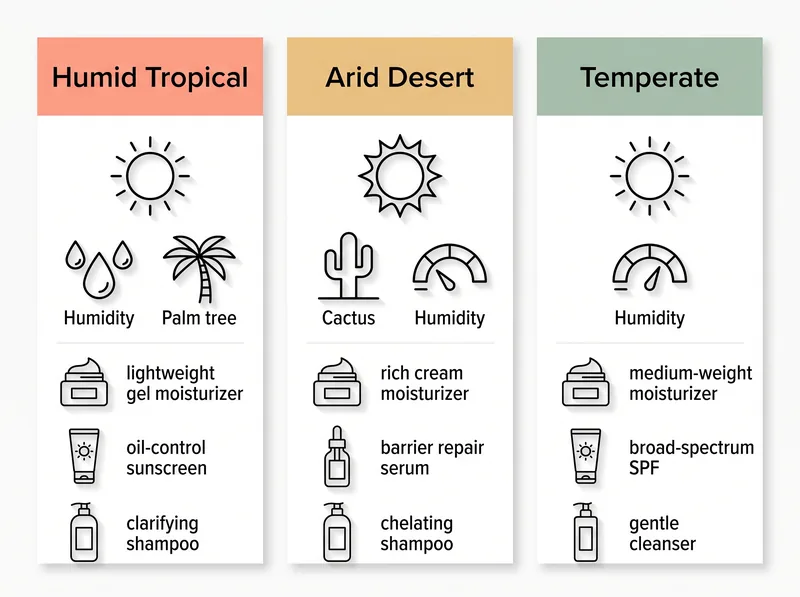 How climate type determines which travel products you actually need in your kit
What Actually Goes in the Kit: The Essentials
Start with the non-negotiables. You need a chelating shampoo if you’re traveling between hard and soft water regions. Mineral buildup from hard water doesn’t rinse out in soft water without help, and soft water can make hair feel limp if you’re used to hard water’s texture. A travel-size chelating shampoo like Regrowth+ removes mineral deposits without the full reset of a clarifying treatment.
Second essential: a barrier repair serum or moisturizer. Climate shifts stress your skin barrier. You want something with ceramides, niacinamide, or centella asiatica that can adapt to both humid and dry conditions. Look for a texture that layers well, not a heavy cream that’ll feel wrong in tropical heat.
Third: a mineral sunscreen rated SPF 50+. Chemical sunscreens degrade faster in extreme heat and high UV environments. Mineral formulas with zinc oxide or titanium dioxide stay stable. Yes, they’re harder to blend, but they won’t fail you at 40 degrees Celsius.
Fourth: a hydrating facial mist or essence. Airplane cabins drop humidity to 10-20%, which is lower than most deserts. A mist rehydrates without adding oil or weight. Use it on the flight, use it when your skin feels tight in a new climate.
The Three-Bag System: Carry-On, Backup, Checked
Here’s the organizational framework that actually works: three separate bags with different purposes.
Bag one is your carry-on daily kit. This goes in your personal item. It contains the 7-10 products you’ll use every single day for the first week: cleanser, moisturizer, sunscreen, chelating shampoo, conditioner, serum, lip balm. All TSA-compliant sizes, all in one clear quart bag. This bag never leaves your sight.
Bag two is your backup kit for week two or climate shifts. It lives in your checked luggage but transfers to your carry-on if you’re doing a multi-leg trip. It holds your second moisturizer (the richer or lighter one depending on where you’re going), a treatment serum, hair mask, eye cream. These are the products you’ll need once your skin adjusts or if the climate is different than expected.
Bag three is checked luggage overflow. Full-size products, body lotion, makeup remover, anything over 100ml. This is your safety net. If you run out of something critical, you have backups. If your carry-on gets lost, you’re not starting from zero.
The system prevents both over-packing and under-packing. You’re not hauling your entire bathroom, but you’re also not rationing a single 30ml moisturizer for two weeks in a climate that demands more.
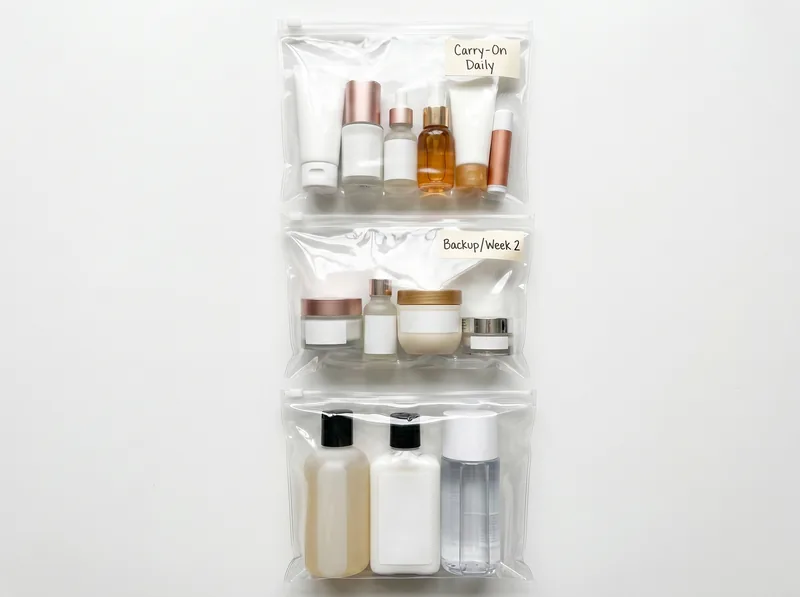 The three-bag system: daily essentials, backup products, and checked luggage overflow
Climate-Specific Swaps: What Changes Based on Destination
If you’re traveling from the Gulf to Northern Europe, swap your lightweight gel moisturizer for a cream formula. Soft water and lower humidity mean your skin loses moisture faster than you expect. Add a facial oil for nighttime. Your hair will likely need less protein and more moisture, so switch to a hydrating conditioner instead of a strengthening one.
If you’re going from a temperate climate to the Gulf, do the opposite. Your cream moisturizer will feel suffocating in 85% humidity. Switch to a gel or gel-cream hybrid. Your sunscreen needs to be sweat-resistant and at least SPF 50. Your chelating shampoo becomes critical here because the hard water will coat your hair in minerals within days.
Tropical beach destinations require oil-control products even if you don’t normally need them. The combination of heat, humidity, and salt water creates a perfect storm for clogged pores and greasy hair. Pack a clarifying cleanser, a lightweight moisturizer with niacinamide, and a leave-in conditioner that won’t weigh hair down.
For dry, high-altitude destinations like mountain regions, you need occlusive moisturizers and a heavier hand with everything. The air is thinner, UV is more intense, and humidity is low. Your lips will crack, your cuticles will split, and your hair will generate static. Pack a thick balm, a rich moisturizer, and a smoothing hair serum.
The Flight Itself: In-Transit Skincare
Long-haul flights are their own microclimate, and they wreck your skin and hair if you don’t prepare. The cabin humidity drops to 10-20%, which is drier than the Sahara. Your skin barrier starts breaking down after about four hours of exposure.
Before boarding, apply a thick layer of moisturizer or a sleeping mask. Don’t blend it in completely. You want a visible layer. Reapply every three hours during the flight. Use your hydrating mist between applications. Skip makeup entirely or remove it an hour into the flight.
For hair, tie it up loosely to minimize friction against the headrest. If you’re on a flight longer than eight hours, apply a leave-in conditioner or hair oil mid-flight. The recycled air will dry out your ends even if you’re not moving. This is especially true if you’re traveling from a humid climate to a dry one, or vice versa.
Drink more water than feels necessary. The rule is 250ml per hour of flight time. Yes, that means frequent bathroom trips. It’s worth it. Dehydration shows up on your face within 12 hours, and it compounds if you’re landing in a climate that’s already challenging for your skin.
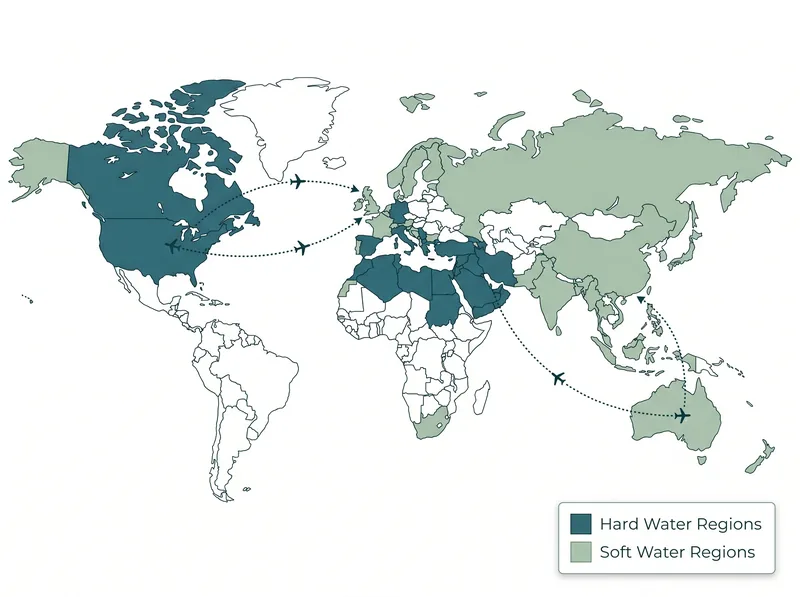 Common travel routes between hard-water and soft-water destinations and what that means for your hair
Post-Arrival Recovery: The First 48 Hours
Your skin and hair need a reset period when you arrive. Don’t expect them to behave normally for at least two days. Your skin barrier is compromised from the flight. Your hair is coated in whatever water you last washed it in, plus airplane air residue.
First shower at your destination: use your chelating shampoo regardless of the local water type. You’re removing the old environment before adapting to the new one. Follow with a deep conditioner and leave it on for 10 minutes. Your hair needs this reset.
For skin, double cleanse the first night even if you don’t wear makeup. You’re removing flight residue, sunscreen from travel day, and environmental buildup. Then apply your barrier repair serum and a heavier moisturizer than you’d normally use. Your skin is in recovery mode.
Days two and three, watch how your skin responds to the new water and climate. Is it getting oilier? Switch to your lighter moisturizer. Is it getting drier or tighter? Add a facial oil or switch to your richer cream. Your skin will tell you what it needs if you’re paying attention.
What Not to Pack: The Overrated Travel Products
Sheet masks sound like perfect travel products. They’re not. They’re bulky, they leak if your luggage gets jostled, and they’re single-use. A small bottle of serum or essence gives you the same benefits in a fraction of the space. If you love masks, bring one for the flight and that’s it.
Travel-size makeup removers are usually a waste. A cleansing balm or oil in a small jar does the same job and doubles as a deep cleanser. You don’t need both. Micellar water is fine if you prefer it, but it’s not essential if you have a good cleanser.
Hair styling tools. Unless you’re traveling for work that requires daily heat styling, leave them home. Most hotels have hairdryers. Your hair will be adjusting to a new climate anyway, and adding heat stress on top of environmental stress accelerates damage. Let your hair air-dry for the first few days.
Expensive full-size products you’re emotionally attached to. If losing it would ruin your trip, don’t pack it. Luggage gets lost. Bottles leak. Hotel housekeeping accidentally throws things away. Bring the products you can afford to replace, not the ones that would devastate you.
Building Your Personal Kit: The Decision Framework
Here’s how to decide what actually goes in your kit. Start with your home climate and your destination climate. Identify the biggest difference: is it water hardness, humidity, UV intensity, or temperature? That difference determines your priority swaps.
If water hardness is the main shift, your hair products are the priority. Chelating shampoo, conditioner suited to the destination water type, and a leave-in treatment. Your skincare can stay mostly the same with minor texture adjustments.
If humidity is the main shift, your moisturizer and sunscreen are the priority. You need formulas that won’t suffocate in high humidity or evaporate in low humidity. Your hair products can stay similar unless you’re also dealing with a water hardness change.
If UV intensity is the main shift, your sunscreen and antioxidant serums are the priority. You need higher SPF, more frequent reapplication, and products that repair UV damage. Consider adding a vitamin C serum if you’re going somewhere with intense sun exposure.
Test your travel kit at home before you leave. Use only the products you’ve packed for three days. If something feels wrong, you have time to adjust. If you run out of something, you know you need a backup. This trial run prevents the panic of realizing you packed the wrong moisturizer while you’re already in a different country.
References
- Aircraft Cabin Air Quality and Passenger Health - PubMed
- Water Hardness and Alkalinity in the United States - US Geological Survey
- Skin Barrier Function and Environmental Stressors - PubMed Central
- Effects of Hard Water on Hair and Skin - International Journal of Trichology